Showing posts with label Java EE6. Show all posts

Tuesday, August 03, 2010

Dependency Injection in Java EE 6 - Part 5

From http://www.theserverside.com/feature/Dependency-Injection-in-Java-EE-6-Part-5

This series of articles introduces Contexts and Dependency Injection for Java EE (CDI), a key part of the Java EE 6 platform. Standardized via JSR 299, CDI is the de-facto API for comprehensive next-generation type-safe dependency injection as well as robust context management for Java EE. Led by Gavin King, JSR 299 aims to synthesize the best-of-breed features from solutions like Seam, Guice and Spring while adding many useful innovations of its own.
In the previous articles in the series, we discussed basic dependency injection, scoping, producers/disposers, component naming, interceptors, decorators, stereotypes, events and conversations. In this article we will discuss CDI’s interaction with JSF in detail. In the next and last article of this series, we will cover portable extensions, available implementations as well as CDI alignment with Seam, Spring and Guice. We will augment the discussion with a few implementation details using CanDI, Caucho’s independent implementation of JSR 299 included in the open source Resin application server.
CDI and JSF
A majority of CDI features are generic to all tiers of a Java EE application and not specific to JSF. In fact most CDI features are useful even in a Java SE application. However, there are a few CDI features that are specific to the web tier and there are many middle-tier oriented features that can be combined in powerful ways with JSF. In the following sections we will explore how features like CDI component naming, scopes, injection, producers, qualifiers and EJB 3 services can be used effectively with JSF.
Note JSF 2 retains its own web tier component model via the @ManagedBean set of annotations as well as annotations for the view, request, session and application scopes. Indeed, you can use EJB 3 and JSF 2 without CDI if you so wish. However there are few compelling reasons to do so considering the much richer set of CDI features that can be used with JSF 2 and EJB 3, including the ones we will discuss here.
Component naming via the @Named annotation is perhaps the easiest place to start. As discussed in the second article in the series, it is the critical link between the type-based Java component world and the string identifier based JSF/Facelet world. Besides making a CDI component available through EL binding expressions by assigning it a resolvable name, the @Named annotation is also useful for overriding the default name of a bean to make it more readable in EL. As the examples in the second article demonstrate, you could shorten the name of a component from the default “bidItemPostingWizard” to simply “itemWizard”:
@ConversationScoped @Named(“itemWizard”)
public class BidItemPostingWizard
Besides providing the critical CDI-JSF linkage, the @Named annotation is fairly unremarkable so we won’t discuss it further here besides using it in the JSF/CDI example use-cases in the following sections.

Web Frameworks other than JSF
Although this article covers JSF 2 only, CDI can also be used in a more-or-less similar fashion with Web Frameworks like Wicket or even Struts 2. Indeed, Seam 3 already supports Wicket and we are considering Struts 2 integration as part of Resin/CanDI. Would such integration be helpful to you?

CDI Contexts and JSF
CDI automatic context management complements JSF’s component-oriented model in very powerful ways by abstracting away boilerplate HTTP request, session and cookie manipulation code. We discussed CDI scopes and context management in detail in the very first article of the series. We also focused on just the innovative conversation scope in the fourth article, including JSF examples. Context management centers on the ability to transparently place managed beans into a declared scope and injecting them from the scope when needed. The striking effect of this capability is generally most noticeable to developers using action-oriented web frameworks like Struts.
Let’s take an example common to most applications to illustrate some of this – a login component. Such a component in its most basic form would be able to handle the login event. The login information should also be saved into the session after the login completes so that it can be retrieved where needed throughout the session. You can accomplish this by simply creating a CDI session scoped login component:

@Named
@SessionScoped
public class Login implements Serializable {
  @Inject
  private UserService userService;

  private String username;
  private String password;
  private User user;

  public void setUsername(String username) {
    this.username = username;
  }

  public String getUsername() {
    return username;
  }

  public void setPassword(String password) {
    this.password = password;
  }

  public String getPassword() {
    return password;
  }

  public void setUser(User user) {
    this.user = user;
  }

  public User getUser() {
    return user;
  }

  public String login() {
    user = userService.getUser(username);
    ...
    return "account.jsf";
  }
}
You would use the component in a JSF page to handle the login event as follows:
<h:form>
  <h1>Login</h1>
  <h:panelGrid columns="2">
    <h:outputLabel for="username">Username:</h:outputLabel>
    <h:inputText id="username" value="#{login.username}"/>
    <h:outputLabel for="password">Password:</h:outputLabel>
    <h:inputSecret id="password" value="#{login.password}"/>
  </h:panelGrid>
  <h:commandButton value="Login" action="#{login.login}"/>
</h:form>

The username and password properties are bound to input text fields while the login method is bound to the login event. The login method uses the injected user service to retrieve user details. These user details can then be accessed by any other component since the login component is placed in the session scope. For example the component to add a bid could use the login data as follows:
@Named
@RequestScoped
public class BidManager {
  @Inject
  private BidService bidService;

  @Inject
  private Login login;

  @Inject @SelectedItem
  private Item item;

  @Inject
  private Bid bid;

  public String addBid() {
    bid.setBidder(login.getUser());
    bid.setItem(item);
    bidService.addBid(bid);

    return “bid_confirm.xhtml”;
  }
}
CDI resolves the injection request to the login component stored in the session scope. Note that the bid manager component itself is in the request scope so in this example we are retrieving data stored in the underlying HTTP session into the HTTP request context. Without automatic context management, you would have to save the user information into the HTTP session yourself and retrieve it manually when needed via boilerplate API calls. Typical manual session manipulation code is usually also accompanied by needless database look-ups. In our example, most naive developers would likely only store a user identifier into the session on login and look-up the user data from the database when the bid is added.
You should also note the other interesting things going on in the bid manager component. The injection of the back-end bid service is pretty straightforward. However, the bid and item injection is more interesting. The item object being injected was likely placed into scope before the bid was placed and has the selected item qualifier placed on it. We will see how CDI qualifiers can be used effectively at the presentation tier shortly. Similarly, the injected bid object encapsulates bid data such as the bid amount. This serves to better model the presentation tier in an object oriented fashion and also promotes the reuse of domain objects across tiers (for example, the bid object could be a JPA mapped entity). You can use a similar technique to better model our example login component:
@Named
@SessionScoped
public class Login implements Serializable {
  @Inject
  private Credentials credentials;

  @Inject
  private UserService userService;

  private User user;

  public void setUser(User user) {
    this.user = user;
  }

  public User getUser() {
    return user;
  }

  public String login()
  {
    user = userService.getUser(credentials.getUsername());
    ...
    return "account.jsf";
  }
}

@Named
@RequestScoped
public class Credentials {
  private String username;
  private String password;

  public void setUsername(String username) {
    this.username = username;
  }

  public String getUsername() {
    return username;
  }

  public void setPassword(String password) {
    this.password = password;
  }

  public String getPassword() {
    return password;
  }
}  
We have re-factored out the username and password fields into a request scoped credentials component that is injected into the login component. Because the credentials are in the request scope and not the session scope, they are discarded right after the login event, which is what we really want to have happen anyway. The re-factored JSF page will look like this and is probably a readability improvement as well:
<h:form>
  <h1>Login</h1>
  <h:panelGrid columns="2">
    <h:outputLabel for="username">Username:</h:outputLabel>
    <h:inputText id="username" value="#{credentials.username}"/>
    <h:outputLabel for="password">Password:</h:outputLabel>
    <h:inputSecret id="password" value="#{credentials.password}"/>
  </h:panelGrid>
  <h:commandButton value="Login" action="#{login.login}"/>
</h:form>

You can freely interweave object scopes as your application requirements evolve. You can inject session scoped objects into request or conversation scoped objects, application scoped objects into session scoped objects, request scoped objects into session scoped objects and the like. CDI proxies make sure that there is not an issue even if a narrower scoped object is injected into a broader scoped object – CDI will always resolve to the currently active instance under the hood. For example, if a request scoped object is injected into a conversational component, CDI will ensure that the conversational component always references the most up-to-date request scoped object via the injected proxy. As an exercise, you should try to think about how you would code a conversation scoped user preferences wizard to add one or more request scoped preferences (hint: you would inject the request scoped preferences object and use it in the method to add a preference to the current set - the correct request scoped reference will be resolved automatically even after initial injection). 

Producers in JSF
We discussed CDI producers in detail in the second article in the series. In most cases, components in the web tier will be defined statically. However, just as is the case with back-end components, it is sometimes useful to generate components dynamically in the web tier via producers. Let’s revisit our login component as an example. If you look carefully you’ll notice that the bid manager component really does not need a reference to the login component per se. What it really needs is the user object that the login component holds a reference to. Injecting the login component instead of the user component makes our code less loosely coupled. This problem can easily be solved by introducing a producer in the login component:
@Named
@SessionScoped
public class Login implements Serializable {
  @Inject
  private Credentials credentials;

  @Inject
  private UserService userService;

  private User user;

  public String login()
  {
    user = userService.getUser(credentials.username);
    ...
    return "account.jsf";
  }

  @Produces
  public User getCurrentUser()
  {
    return user;
  }
}

@Named
@RequestScoped
public class BidManager {
  @Inject
  private BidService bidService;

  @Inject
  private User user;

  @Inject @SelectedItem
  private Item item;

  @Inject
  private Bid bid;

  public String addBid() {
    bid.setBidder(user);
    bid.setItem(item);
    bidService.addBid(bid);

    return “bid_confirm.xhtml”;
  }
}
Although in this example the producer method itself is in a session scoped bean, producers can be encapsulated in pure factory objects just as in the example in the second article. In such a case, you will likely want to attach an appropriate scope to the producer method like this:
@Produces @SessionScoped
public User getCurrentUser()
{
  ...
}
You can also use CDI producers (in particular producer fields) for better encapsulation and improving readability in JSF. Let’s take a look at the following simplified component to place a bid:
@RequestScoped @Named
public class PlaceBid {
  @Inject
  private BidService bidService;

  @Produces @Named
  private Bid bid = new Bid();

  public void placeBid() {
    bidService.addBid(bid);
  }
}
In this example, instead of embedding the fields of the bid in the place bid component, we have better encapsulated it in the bid object and exposed the bid object as a named producer field. The corresponding JSF component will look something like this:
<h:form>
  <table>
    <tr>
      <td>Bidder</td>
      <td><h:inputText value="#{bid.bidder}"/></td>
    </tr>
    <tr>
      <td>Item</td>
      <td><h:inputText value="#{bid.item}"/></td>
    </tr>
    <tr>
      <td>Bid Amount</td>
      <td><h:inputText value="#{bid.price}"/></td>
    </tr>
  </table>
  ...
  <h:commandButton type="submit" value="Place Bid"
    action="#{placeBid.placeBid}"/>
  ...
</h:form>

Without the named producer, the bid fields could still be referenced in EL but would be much less readable as below:

This technique is especially helpful for complex forms with many inputs that might be best grouped into separate objects exposed by named producers from a master form handler.
CDI Qualifiers and JSF
Qualifiers are invaluable particularly while using CDI producers with JSF. We discussed qualifiers in detail in the first article of the series. Unlike business and persistence tier components, you typically will not need to swap out implementations at the web tier using qualifiers. However, while creating dynamic components, it is often necessary to qualify them to reduce the possibility of an accidental dependency collision. Let’s revisit the login component to see why this might be the case with CDI producers:
@Named @SessionScoped
public class Login implements Serializable {
  ...
  @Produces
  public User getCurrentUser()
  {
    return user;
  }
}

@Named @RequestScoped
public class BidManager {
  ...
  @Inject
  private User user;
  ...
}
The problem with the code above is that there might be other dynamically produced user objects in the session or request scopes. For example, there might be a currently selected seller or customer service agent that is also a user object for the same session. Imagine this code used from the customer service live chat screen:
@Named @SessionScoped
public class CustomerService implements Serializable {
  ...
  @Produces @Agent
  public User getSelectedAgent()
  {
    return selectedAgent;
  }
}
Because there will now be two candidates for the injection point in the bid manager it will become ambiguous as to which one to inject at runtime. The best way to resolve the dependency correctly would be to introduce a qualifier:
@Named @SessionScoped
public class Login implements Serializable {
  ...
  @Produces @LoggedIn
  public User getCurrentUser()
  {
    return user;
  }
}

@Named @RequestScoped
public class BidManager {
  ...
  @Inject @LoggedIn
  private User user;
  ...
}
Besides avoiding possible dependency collisions, adding qualifiers to producers generally improves readability, as is illustrated in our example. Both the producer and the injection point make it clear what type of user is expected at runtime.
Flattened Layers with JSF
Most server-side Java applications are typically built with large teams, heavy maintenance and longevity in mind. This is one reason layering is so popular in Java EE applications. Layers improve testability, enforce separation of concerns, help skills specialization and make it easier to replace the implementation of a specific layer. However, layering can be overkill for smaller teams, smaller applications and prototypes.
Keeping this fact in mind, CDI allows you to flatten the business/transactional and persistence tiers if you so wish. It enables this by allowing you to use EJB 3 and JPA directly with JSF without any intermediate service or DAO tiers. For example, the simplified bid manager component we looked at earlier can be re-factored to be a session bean that uses an injected JPA entity manager directly:
@Stateful @RequestScoped @Named
public class BidManager {
  @PersistenceContext
  private EntityManager entityManager;

  @Produces @Named
  private Bid bid = new Bid();

  public void addBid() {
    entityManager.persist(bid);
  }
}
Because it is an EJB, the bid manager is automatically thread-safe so it can use the non-thread-safe entity manager reference directly and is also transactional by default. The JSF page using the bean would remain unchanged:
<h:form>
  <table>
    <tr>
      <td>Bidder</td>
      <td><h:inputText value="#{bid.bidder}"/></td>
    </tr>
    <tr>
      <td>Item</td>
      <td><h:inputText value="#{bid.item}"/></td>
    </tr>
    <tr>
      <td>Bid Amount</td>
      <td><h:inputText value="#{bid.price}"/></td>
    </tr>
  </table>
  ...
  <h:commandButton type="submit" value="Place Bid"
    action="#{bidManager.addBid}"/>
  ...
</h:form>

As the application evolves, you could, of course, always re-factor the flattened components into web, domain, business and persistence tiers. The capacity to use EJB 3 and JPA directly with JSF simply gives you some added flexibility when you need it.

Using EJB Services Outside the Component Model
You can flatten the application tiers in Resin 4 without needing to use EJB per se by directly adding EJB services such as transactions to CDI managed beans. In our example, you would add the @TransactionAttribute annotation instead of the @Stateful annotation to make the bid manager transactional. Entity manager thread-safety is not an issue in Resin 4 since all JPA provided entity managers are automatically wrapped in a thread-safe proxy.

More to Come
Besides the CDI features we discussed in detail here, there are many other CDI features that can be used in powerful ways with JSF. You can use CDI stereotypes to define components specific to the web tier in addition to the built-in @Model stereotype. For example, you could add a @Wizard stereotype that is named, conversation scoped and attaches interceptors/decorators specific to wizard components. You could use CDI events to trigger actions from the web tier in a loosely-coupled fashion. You could also use the features we described here in many other innovative ways for your particular application. We encourage you to further explore these possibilities on your own.
As we mentioned at the beginning of the article, we are now almost at the end of this series and hope it was useful to you. In the next and last article of this series we will discuss CDI portable extensions, CDI’s alignment with Seam, Guice, Spring, etc as well as the current implementations of CDI including Weld/Seam 3, OpenWebBeans and CanDI.
In the meanwhile, for comments on CDI, you are welcome to send an email to jsr-299-comments@jcp.org. You can also send general comments on Java EE 6 to jsr-316-comments@jcp.org. For comments on the article series, Resin or CanDI, our JSR 299 implementation, feel free to email us at reza@caucho.com or ferg@caucho.com. Adios Amigos!

Wednesday, May 19, 2010

Contexts and Dependency Injection for Java EE (CDI) - Part 4

From http://www.theserverside.com/tip/Dependency-Injection-in-Java-EE-6-Conversations-Part-4

This series of articles introduces Contexts and Dependency Injection for Java EE (CDI), a key part of the Java EE 6 platform. Standardized via JSR 299, CDI is the de-facto API for comprehensive next-generation type-safe dependency injection as well as robust context management for Java EE. Led by Gavin King, JSR 299 aims to synthesize the best-of-breed features from solutions like Seam, Guice and Spring while adding many useful innovations of its own.

In the previous articles in the series, we discussed basic dependency injection, scoping, producers/disposers, component naming, interceptors, decorators, stereotypes and events. In this article we will discuss CDI Conversations in detail. In future articles, we will cover details of using CDI with JSF, portable extensions, available implementations as well as CDI alignment with Seam, Spring and Guice. We will augment the discussion with a few implementation details using CanDI, Caucho’s independent implementation of JSR 299 included in the open source Resin application server.
The Concept of Conversations
In the first article of the series, we discussed conversations very briefly from the perspective of CDI scopes in general. The conversation scope is an idea that comes from Seam and deserves a detailed look, especially for understanding how to use it with JSF.
Most server-side Java developers are very familiar with the request and session scopes. That is likely how you started web application state management, probably using the programmatic APIs defined in the Servlet specification. As a result, it is pretty obvious how the CDI request and session scopes are used with JSF through @RequestScoped and @SessionScoped beans (although we will still discuss this in some detail in the next article in the series). The most typical use of a @RequestScoped bean is as a JSF backing bean for a single page handling one HTTP request/response cycle. The vast majority of CDI beans you will use with JSF will likely belong to the request scope. In a similar vein, @SessionScoped beans are used for objects that are used throughout the HTTP session. Examples of this include user login credentials, account details and so on.
There is a relatively large class of web application use-cases that fall between these two logical extremes. There are some presentation tier objects that can be used across more than one page/request but are clearly not used across the entire session. Such objects are usually used in multi-step workflows. Unlike session scoped objects that are usually timed-out, conversation scoped objects have well-defined life-cycle start and end-points that can be determined ahead of time. A good example use-case for the conversation scope is an online quiz or questionnaire (both of which I’m sure we’ve all encountered much more frequently than we would like). While such use-cases are often implemented as part of the HTTP session, there really is no good reason to do so since the life-cycle of a quiz or questionnaire can be pretty well-defined and they are not needed across the entire session. The life-cycle of a quiz/questionnaire would begin with the first question. As part of the application workflow, the user will progress through questions. The user may also go back and forth through responses an arbitrary number of times. Finally, the quiz/questionnaire would end its life-cycle after the user finalizes their responses. Infrequently, the user will simply abandon the quiz/questionnaire, so conversation scoped objects do still need a timeout mechanism in case the event that defines the end of the workflow never happens. An order process that translates a shopping cart into a finalized checkout is another good candidate for the conversation scope since it will typically be a multi-step wizard.
Another way to think about the conversation scope is that it is a truncated custom session with the developer programmatically determining where the scope begins and ends. The concept of conversations will become even clearer as we look at a concrete example with code.
A Conversational Example
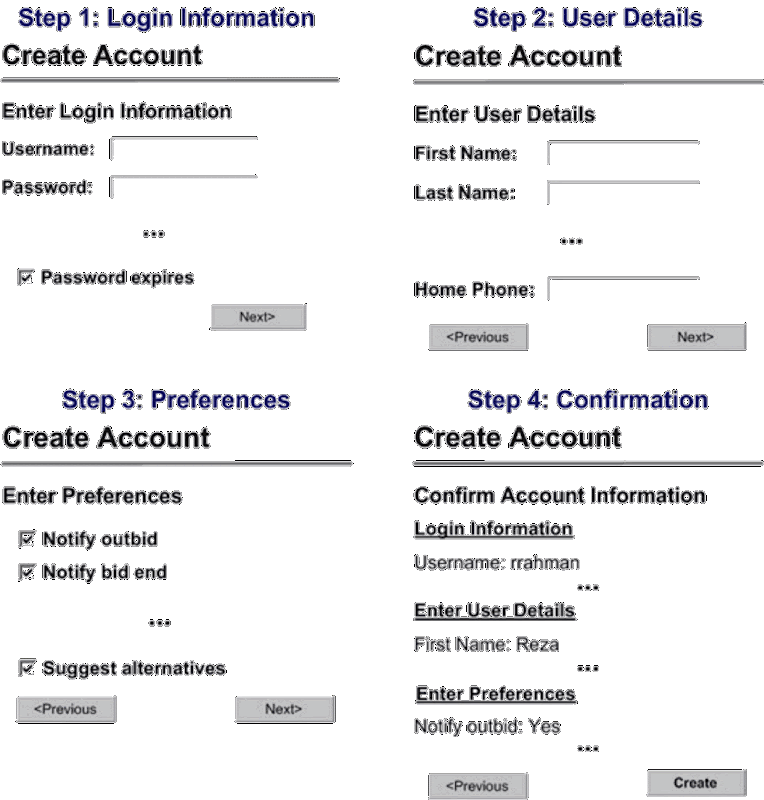
To borrow a convenient example from EJB 3 in Action, the bidder account creation wizard in the eBay-like ActionBazaar makes another great candidate use-case for the conversation scope. As shown in Figure 1, the wizard is composed of fours steps. In the first step, the user will enter login information such a username, password, password confirmation, secret question/answer, etc. When the user clicks the “Next” button, the information in the first step is saved and the user is taken to the second step. In the second step, user details such as the first name, last name, address, email and contact information is collected and saved. The wizard also allows the user to backtrack to the previous step and change the previously entered information.


Similarly, the third step collects user preferences such as notification and display preferences. The final step of the wizard confirms all the collected bidder account information before actually creating the account. The first step of the wizard starts the conversation while the conversation scope should end when the account is created in the last step of the wizard.
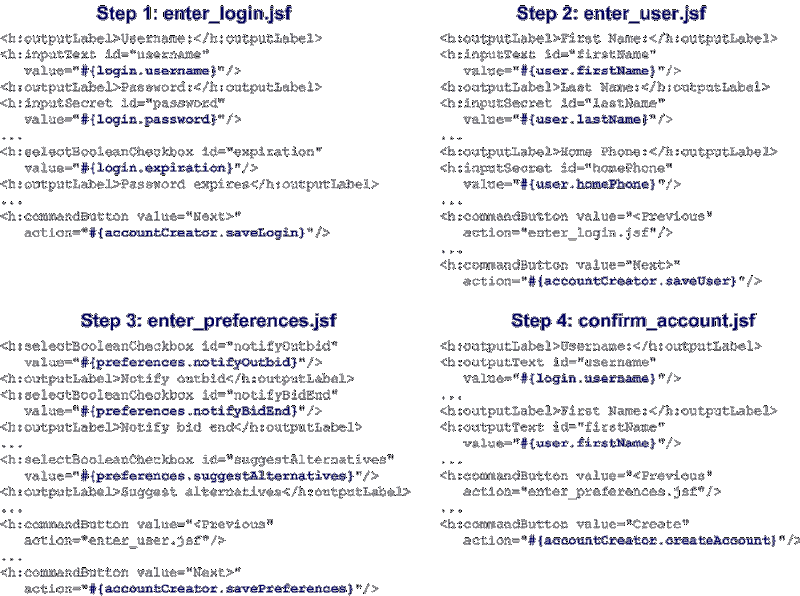
The entire account creation wizard can be implemented through a single conversation scoped bean. Before we look at how the bean is implemented, let’s take a brief look at the relatively unsophisticated JSF Facelets for the wizard. Figure 2 shows the JSF code that corresponds to each of the pages in Figure 1.


The enter_login.jsf page implements the first page of the wizard (in case of Facelets the actual source code file name is likely enter_login.xhtml). The login input is bound to a bean named login while the “Next” button is bound to accountCreator.saveLogin. As we will see shortly, the accountCreator bean is a conversation scoped bean that models the workflow. The login bean, on the other hand, is a simple data holder backing bean produced by the accountCreator bean. The second page in the workflow, enter_user.jsf similarly uses a produced backing bean named user and the “Next” button is bound to accountCreator.saveUser. The “Previous” button maps directly to the first page in the wizard. The enter_preferences.jsf page is implemented in a very similar fashion. The final page in the wizard, confirm_account.jsf, displays the values collected by the wizard during the conversation and also binds the event handler that triggers the actual creation of the account and the end of the workflow, accountCreator.createAccount.
Let’s now take a close look at the conversation scoped bean that implements the wizard:


@Named
@ConversationScoped

public class AccountCreator {
  @Inject
  private AccountService accountService;
  @Inject
  private Conversation conversation;
  @Named
 @Produces
  public Login login = new Login();
  @Named
  @Produces

  public User user = new User();
  @Named
  @Produces

  public Preferences preferences = new Preferences();
   public String saveLogin() {
    conversation.begin();
    ...
    return “enter_user.jsf”;
   }

   public String saveUser() {
    ...
    return “enter_preferences.jsf”;
   }

   public String savePreferences() {
    ...
    return “confirm_account.jsf”;
   }

   public String createAccount() {
    Account account = new Account();
    account.setLogin(login);
    account.setUser(user);
    account.setPreferences(preferences);
    accountService.createAccount(account);
    conversation.end();
    return “/home.jsf”
   }

}


The bean is annotated to be both @Named so that it can be referenced from EL as well as @ConversationScoped. The login, user and preferences fields produce named backing beans for use in the wizard pages. Because these beans are produced by the conversational bean, they are available throughout the conversation as well as being available to the parent bean holding the bean instances. It is very important to note that a handle to the Conversation itself is injected into the bean. As we will discuss in greater detail both in this section as well as the next section, the Conversation interface allows programmatic control over the life-cycle of the conversation scope. This interface is basically what allows you to “custom-fit” the conversation to your application. A back-end service to actually create the account is also injected and is presumably implemented as a transactional stateless session bean. The JSF event listener methods in AccountCreator is actually where most of the interesting stuff is going on. The saveLogin method is called on the first page of the wizard and actually starts the long-running conversation. To understand what that means, you’ll have to know about types of conversations in CDI.
CDI has two different types of conversations, transient and long-running. By default, when you annotate a bean with @ConversationScoped, it is assumed to be transient. A transient conversation ends when the request that originated the conversation ends. This is a sensible fail-safe in case a conversational bean does not really need to be extended beyond the request. Any transient conversation can be turned into a long-running conversation on demand. Unlike a transient conversation, a long-running conversation extends beyond the scope of a request, potentially as long as the whole application session. A transient conversation is turned into a long-running conversation by invoking the Conversation.begin method, as is done in the saveLogin method. If the saveLogin method is not invoked, for example if the user abandoned the wizard at the first step, the bean will never be put into a long-running conversation and will simply be disposed of at the end of the request as part of the transient conversation. Besides starting the long running conversation, a number of other things can possibly be done in the saveLogin method, including perhaps validating that the username does not already exist, the password matches the confirmed password or that the password meets security guidelines. The saveLogin method also moves the wizard to the next page by returning the “enter_user.jsf” URL as the outcome for the event.
No specific manipulation of the conversation is done in the next page of the wizard, except for binding more input values to the user produced bean and the saveUser event handler likely only does some form-level validation before forwarding to the enter_preferences.jsf page. The savePreferences event handler is similarly simplistic. The event handler method for the final page in the wizard, createAccount, does a number of interesting things, however. It actually creates the final Account object with all the input collected into the produced fields throughout the conversation and invokes the back-end service to save the newly created account into the database. It then invokes the Conversation.end method. As you can guess, the Conversation.end method ends the long running conversation. This does not mean however that the conversation is immediately destroyed; it simply means that the conversation is “demoted” to becoming transient again. This allows for the conversational bean to be destroyed when the request ends and the user is moved out of the wizard into the “/home.jsf” URL.
An interesting question to think about is what happens if the user abandons the wizard in the middle after the long-running conversation is started. The bean will of course not be destroyed when a request ends. Like sessions, long-running conversations have an implicit timeout. When this timeout value expires, the conversation is destroyed. This timeout value is typically shorter than a session timeout. An astute reader might also wonder what happens if the saveLogin method (and therefore the Conversation.begin) is invoked twice during the same conversation, or if the Conversation.end method is invoked while the conversation is still transient. In most real applications, the begin and end methods should always be invoked after checking the current state of the conversation using the other methods in the Conversation interface described in detail below.


Programmatic vs. Declarative Conversations
It is an interesting question to ask whether the programmatic model of injecting the conversation and calling the begin and end methods could be converted to a declarative equivalent. For example, instead of injecting the conversation, we could have used something like @Begin and @End on the saveLogin and createAccount methods.
While this is not currently supported in CDI, it is the model that was supported in previous versions of Seam and will likely still be supported in Seam 3. If you believe it is useful, this is something we can support in Resin 4 as well.


More on Conversations
In order to make effective use of the conversation scope, it is helpful to understand a little bit of how it is implemented under-the-hood. CDI keeps track of a long running conversation by propagating an HTTP GET parameter named cid (reserved by the specification) across requests that are part of a workflow. The ID is created when the conversation starts and the cid that is passed around from request-to-request is mapped to the correct conversation context at runtime on subsequent requests in the workflow. When CDI cannot find a cid in the request, it assumes that a new conversation should be started. The ID itself is usually automatically generated, but you can create it manually yourself and retrieve it when needed (see the table below). As matter of fact, the cid can even be propagated back and forth from JSF and non-JSF pages (such as Servlets that are aware of CDI).
Below are all the methods that are supported by the Conversation interface:

Method
Description
void begin() The method promotes the conversation to being long-running. If the conversation is already long-running, an IllegalStateException is thrown. When the conversation is promoted, CDI automatically generates a unique ID and assigns it to the conversation – this is the ID that is used in the cid parameter.
void begin(String id) This variant of the begin method allows you to provide an application defined ID for the conversation. You may want to do this, for example, if you wanted to track the conversations for your application by assigning some custom meaning to it.
void end() This method demotes a long-running conversation to become transient. If the conversation is not long-running, an IllegalStateException is thrown.
String getId() This method returns the identifier of the current long-running conversation, or a null value if the current conversation is transient. The method can be used to send the conversation ID to a non-JSF page by embedding it into a URL or hidden form value, for example.
long getTimeout() This method returns the timeout, in milliseconds, of the current conversation.
void setTimeout(
long milliseconds)
This method sets the timeout of the current conversation. The method could be used as a performance tuning measure or for customizing application behavior (for example, setting idle time for an on-line quiz).
boolean isTransient() This method indicates whether the current conversation is transient. It should be used to check conversation state before invoking the begin and end methods.


It is also important to understand that you can start multiple conversations in the same session. For example, you could open two instances of the enter_login.jsf page in separate tabs. Two different conversations with two different conversation IDs would result. Conversations are thread-safe, meaning that even if you started two concurrent requests, two different conversations would still result.
For further details on the conversation scope such as conversation passivation, feel free to look through the CDI specification (or the Weld reference guide referenced below).
More to Come
Although we have discussed CDI’s interaction with JSF in somewhat greater detail in this article of the series, JSF’s interaction with CDI deserves focused coverage. In the next article of the series, we will focus solely on CDI from a JSF developer’s perspective including CDI’s interaction with JSF using EL binding, scoping, producers, qualifiers, events and the like.
In the meanwhile, for comments on CDI, you are welcome to send an email to jsr-299-comments@jcp.org. You can also send general comments on Java EE 6 to jsr-316-comments@jcp.org. For comments on the article series, Resin or CanDI, our JSR 299 implementation, feel free to email us at reza@caucho.com or ferg@caucho.com. Cheers until next time!
References
1.      JSR 299: Contexts and Dependency Injection for Java EE, http://jcp.org/en/jsr/detail?id=299.
2.      JSR 299 Specification Final Release, https://cds.sun.com/is-bin/INTERSHOP.enfinity/WFS/CDS-CDS_JCP-Site/en_US/-/USD/ViewProductDetail-Start?ProductRef=web_beans-1.0-fr-oth-JSpec@CDS-CDS_JCP.
3.      Weld, the JBoss reference implementation for JSR 299: http://seamframework.org/Weld.
4.      Weld Reference Guide, http://docs.jboss.org/weld/reference/1.0.0/en-US/html/.
5.      CanDI, the JSR 299 implementation for Caucho Resin, http://caucho.com/projects/candi/.
6.      OpenWebBeans, Apache implementation of JSR 299, http://openwebbeans.apache.org.
About the Authors
Reza Rahman is a Resin team member focusing on its EJB 3.1 Lite container. Reza is the author of EJB 3 in Action from Manning Publishing and is an independent member of the Java EE 6 and EJB 3.1 expert groups. He is a frequent speaker at seminars, conferences and Java user groups, including JavaOne and TSSJS.
Scott Ferguson is the chief architect of Resin and President of Caucho Technology. Scott is a member of the JSR 299 EG. Besides creating Resin and Hessian, his work includes leading JavaSoft’s WebTop server as well as creating Java servers for NFS, DHCP and DNS. He lead performance for Sun Web Server 1.0, the fastest web server on Solaris.

Contexts and Dependency Injection for Java EE (CDI) - Part 3

From http://www.theserverside.com/news/2240016831/Part-3-of-dependency-injection-in-Java-EE-6

This series of articles introduces Contexts and Dependency Injection for Java EE (CDI), a key part of the Java EE 6 platform. Standardized via JSR 299, CDI is the de-facto API for comprehensive next-generation type-safe dependency injection as well as robust context management for Java EE. Led by Gavin King, JSR 299 aims to synthesize the best-of-breed features from solutions like Seam, Guice and Spring while adding many useful innovations of its own.
In the previous articles in the series, we took a high-level look at CDI, discussed basic dependency management, scoping, producers/disposers, component naming and dynamically looking up beans. In this article we will discuss interceptors, decorators, stereotypes and events. In the course of the series, we will cover conversations, CDI interaction with JSF, portable extensions, available implementations as well as CDI alignment with Seam, Spring and Guice. We will augment the discussion with a few implementation details using CanDI, Caucho’s independent implementation of JSR 299 included in the open source Resin application server.
Cross-cutting concerns with CDI interceptors
Besides business logic, it is occasionally necessary to implement system level concerns that are repeated across blocks of code. Examples of this kind of code include logging, auditing, profiling and so on. This type of code is generally termed “cross-cutting concerns” (although subject to much analysis as a complement to object orientation, these types of concerns really don’t occur that often in practice). CDI interceptors allow you to isolate cross-cutting concerns in a very concise, type-safe and intuitive way.   
The best way to understand how this works is through a simple example. Here is some CDI interceptor code to apply basic auditing at the EJB service layer:
@Stateless
public class BidService {
    @Inject
    private BidDao bidDao;

    @Audited
    public void addBid(Bid bid) {
        bidDao.addBid(bid);
    }
    ...
}

@Audited @Interceptor
public class AuditInterceptor {
    @AroundInvoke
    public Object audit(InvocationContext context) throws Exception {
        System.out.print("Invoking: "
            + context.getMethod().getName());
        System.out.println(" with arguments: "
            + context.getParameters());
        return context.proceed();
    }
}

@InterceptorBinding
@Target({TYPE, METHOD})
@Retention(RUNTIME)
public @interface Audited {}
Whenever the addBid method annotated with @Audited is invoked, the audit interceptor is triggered and the audit method is executed. The @Audited annotation acts as the logical link between the interceptor and the bid service. @InterceptorBinding on the annotation definition is used to declare the fact that @Audited is such a logical link. On the interceptor side, the binding annotation (@Audited in this case) is placed with the @Interceptor annotation to complete the binding chain. In other words, the @Audited and @Interceptor annotations placed on AuditInterceptor means that the @Audited annotation placed on a component or method binds it to the interceptor.
Note a single interceptor can have more than one associated interceptor binding. Depending on the interceptor binding definition, a binding can be applied either at the method or class level. When a binding is applied at the class level, the associated interceptor is invoked for all methods of the class. For example, the @Audited annotation can be applied at the class or method level, as denoted by @Target({TYPE, METHOD}). Although in the example we chose to put @Audited at the method level, we could have easily applied it on the bid service class instead.
We encourage you to check out the CDI specification for more details on interceptors including disabling/enabling interceptors and interceptor ordering (alternatively, feel free to check out the Weld reference guide that’s a little more reader-friendly).
 
Custom vs. Built-in Interceptors
EJB declarative transaction annotations like @TransactionAttribute and declarative security annotations like @RolesAllowed, @RunAs can be thought of as interceptor bindings built into the container. In fact, this is not too far from exactly how things are implemented in Resin.
In addition to the EJB service annotations, we could add a number of other built-in interceptors for common application use-cases in Resin including @Logged, @Pooled, @Clustered, @Monitored, etc. Would this be useful to you?

Isolating pseudo business concerns with CDI decorators
Interceptors are ideal for isolating system-level cross-cutting concerns that are not specific to business logic. However, there is a class of cross-cutting logic that is closely related to business logic. In such cases, you will have logic that really should be externalized from the main line of business logic but is still very specific to the interception target type, method or parameter values. CDI decorators are intended for such use cases. Like interceptors, decorators are very concise, type-safe and pretty natural.
As in the case with interceptors, the best way to understand how decorators work is through a simple example. We’ll use the convenient bid service example again. Let’s assume that the bid service is used in multiple locales. For each locale bid monetary amounts are entered and displayed in the currency specific to the locale. However, the bid amounts are internally stored using a standardized currency (such as maybe the Euro or the U.S. Dollar). This means that bid amounts must be converted to/from the locale specific currency, likely at the service tier. Because the currency conversion code is not strictly business logic, it should really be externalized, but it is very specific to bid operations. This is a good use case for decorators, as shown in the code below:
@Stateless
public class DefaultBidService implements BidService {
    ...
    public void addBid(Bid bid) {
    ...
}

@Decorator
public class BidServiceDecorator implements BidService {
    @Inject @Delegate
    private BidService bidService;

    @Inject @CurrentLocale
    private Locale locale;

    @Inject
    private Converter converter;

    public void addBid(Bid bid) {
        bid.setAmount(converter.convert(bid.getAmount(),
            locale.getCurrency(), Converter.STANDARDIZED_CURRENCY));

        bidService.addBid(bid);
    }
    ...
}
As you can see from the code example, the currency conversion logic is isolated in the decorator annotated with the @Decorator annotation. The decorator is automatically attached and invoked before the interception target by CDI (just as in the case of interceptors). A decorator cannot be injected directly into a bean but is only used for the purposes of interception. The actual interception target is injected into the decorator using the @Delegate built-in qualifier. As you can also see, decorators can utilize normal bean injection semantics. If the Decorator/Delegate terminology sounds familiar, it is not an accident. CDI Decorators and Delegates essentially implement the well-known Decorator and Delegate OO design patterns. You can use qualifiers with @Delegate to narrow down which class a decorator is applied to like this:
@Decorator
public class BidServiceDecorator implements BidService {
    @Inject @Legacy @Delegate
    private BidService bidService;
    ...
}

The CDI specification (or the Weld reference guide) has more details on decorators including disabling/enabling decorators and decorator ordering.
Custom component models with CDI stereotypes
CDI stereotypes essentially allow you to define your own custom component model by grouping together meta-data. This is a very powerful way of formalizing the recurring bean roles that often arise as a result of application architectural patterns. For example, in a tiered server-side application, you can imagine component definitions for the service, DAO or presentation-tier model (the ‘M’ in MVC). A stereotype consists of a default component scope and one or more interceptor bindings. A stereotype may also indicate that a bean will have a default name (essentially indirectly decorating it with @Named) or that a bean is an alternative (indirectly decorated with @Alternative). A stereotype may also include other stereotypes.
 
Alternatives
An alternative is anything marked with the @Alternative annotation. Unlike regular beans, an alternative must be explicitly enabled in beans.xml. Alternatives are useful as mock objects in unit tests as well as deployment-specific components. Alternatives take precedence over regular beans for injection when they are available.
We won’t discuss alternatives beyond this here, but we encourage you to explore them on your own.

A stereotype defined for the DAO layer in our example bidding application could look like the following:
@Profiled
@Dependent
@Stereotype
@Target(ElementType.TYPE)
@Retention(RetentionPolicy.RUNTIME)
public @interface Dao {
}

As you can see, the @Stereotype annotation denotes a stereotype. Our stereotype is declared to have the dependent scope by default. This makes sense since DAOs are likely injected into EJBs in the service tier. The interceptor binding @Profiled is also included in the stereotype. This means that any bean annotated with the @Dao stereotype may be profiled for performance via an interceptor bound to @Profiled. The stereotype would be applied to a DAO like this:
@Dao
public class DefaultBidDao implements BidDao {
    @PersistenceContext
    private EntityManager entityManager;
    ...
}

To solidify the idea of stereotypes a little more, let’s take a look at another example. CDI actually has a built-in stereotype - @Model. Here is how it is defined:
@Named
@RequestScoped
@Stereotype
@Target({TYPE, METHOD, FIELD})
@Retention(RUNTIME)
public @interface Model {}
The @Model annotation is intended for beans used as JSF model components. This is why they have the request scope by default so that they are bound to the life-cycle of a page and are named so that they can be resolved from EL. This is how @Model might be applied:
@Model
public class Login {
Note it is possible to override the default scope of a stereotype. For example, you can turn the Login bean into a session scoped component like this:
@SessionScoped @Model
public class Login {

It is also possible to place more than one stereotype on a given class, as well as apply additional interceptors, decorators, etc. As we mentioned earlier, stereotypes can also be cumulative, meaning that a stereotype can include other stereotypes in its definition.

 
The EJB Component Model as Stereotypes
It is an interesting question to ask whether the EJB component model (@Stateless, @Stateful, etc) can be modeled simply as a set of highly specialized stereotypes for the business/service tier. This is a logical next step from redefining EJBs as managed beans with additional services as was done in Java EE 6 and could open up some very powerful possibilities for the Java EE component model going forward.
This is one possibility we are actively exploring for the Resin EJB 3.1 Lite container.

Lightweight type-safe events with CDI
Events are useful whenever you need to loosely couple one or more invokers from one or more invocation targets. In enterprise applications events can be used to communicate between logically separated tiers, synchronize application state across loosely related components or to serve as application extension points (think about Servlet context listeners, for example). Naturally CDI events are lightweight, type-safe, concise and intuitive. Let’s look at this via a brief example to see how events in CDI work.
Let’s assume that various components in the bidding system can detect and generate fraud alerts. Similarly, various components in the system need to know about and process the fraud alerts. CDI events are a perfect fit for such a scenario because the producers and consumers are so decoupled in this case. The code to generate a fraud alert event would look like this:
@Inject
private Event fraudEvent;

Fraud fraud = new Fraud();

fraudEvent.fire(fraud);

CDI events are triggered using injected Event objects. The generic type of the Event is the actual event being generated. Like the Fraud object, events are simple Java classes. In our example, we would construct the fraud object and populate it as needed. As you can see, events are triggered by invoking the fire method of Event. When the event is triggered, CDI looks for any matching observer methods that are listening for the event and invokes them, passing in the event as an argument. Here is how an observer method for our fraud alert would look like:
public void processFraud(@Observes Fraud fraud) { ... }
An observer method is simply a method that has a parameter annotated with the @Observes annotation. The type of the annotated parameter must match the event being triggered. The name Observer mirrors the Observer OO design pattern. You can use qualifiers to filter observed events as needed. For example, if we were only interested in seller fraud, we could place a qualifier on the observer method like this:
public void processSellerFraud(@Observes @Seller Fraud fraud) { ... }
On the producer side, there are a couple of ways to attach qualifiers to trigged events. The most simple (and common) way would be to declaratively place a qualifier on the injected event like this:
@Inject @Seller
private Event sellerFraudEvent;
It is also possible to attach qualifiers programmatically using the Event.select method like this:
if (sellerFraud) {
    fraudEvent.select(new Seller()).fire(fraudEvent);
}

There is a lot more to events than this like injecting parameters into observer methods, transactional observers and the like that you should investigate on your own.

 
Events and Messages
There are a lot of obvious parallels between events and traditional messaging with JMS. This is one of the avenues we are exploring further in Resin to see if these models could be merged in a simple and intuitive way – namely if the Event object can be used to send JMS messages and/or if @Observer could listen for JMS messages.

More to come
In the next part of the series we will be focusing on CDI as it relates to JSF developers at the presentation tier (many of you have expressed specific interest in this topic). We will cover using the new conversation scope as well as CDI’s interaction with JSF using EL binding, scoping, producers, qualifiers and the like.
In the meanwhile, for comments on CDI, you are welcome to send an email to jsr-299-comments@jcp.org. You can also send general comments on Java EE 6 to jsr-316-comments@jcp.org. For comments on the article series, Resin or CanDI, our JSR 299 implementation, feel free to email us at reza@caucho.com or ferg@caucho.com. Adios Amigos!
References
1.      JSR 299: Contexts and Dependency Injection for Java EE
2.      JSR 299 Specification Final Release
3.      Weld, the JBoss reference implementation for JSR 299
4.      Weld Reference Guide
5.      CanDI, the JSR 299 implementation for Caucho Resin
6.      OpenWebBeans, Apache implementation of JSR 299
About the Authors
Reza Rahman is a Resin team member focusing on its EJB 3.1 Lite container. Reza is the author of EJB 3 in Action from Manning Publishing and is an independent member of the Java EE 6 and EJB 3.1 expert groups. He is a frequent speaker at seminars, conferences and Java user groups, including JavaOne and TSSJS.
Scott Ferguson is the chief architect of Resin and President of Caucho Technology. Scott is a member of the JSR 299 EG. Besides creating Resin and Hessian, his work includes leading JavaSoft'stable WebTop server as well as creating Java servers for NFS, DHCP and DNS. He lead performance for Sun Web Server 1.0, the fastest web server on Solaris.

Friday, January 22, 2010

Contexts and Dependency Injection for Java EE (CDI) - Part 2


Custom Object Factories with CDI Producers/Disposers
In a majority of cases, @Inject and @Qualifier annotations gives the container static control over object creation. However, there are cases where it makes a lot of sense for you to control object creation and destruction yourself in Java code. Good examples are complex object creation/destruction, legacy/third-party API integration, objects that need to be constructed dynamically at runtime and creating injectable strings, collections, numeric values and so on. Along the same lines as the traditional object factory pattern, this is what CDI producers and disposers allow you to do. Another way of looking at this is that the container allows you to step in and take manual control over creating/destroying objects when it makes sense.

In the following code, we'll show you how to create a simple abstraction over the low-level JMS API using CDI producers and disposers. As you might already know, plain JMS code can be pretty verbose because the API is so general purpose. Using CDI, we can create a custom JMS object factory that hides most of the verbose code to handle the JMS connection and session, keeping the actual JMS API client code pretty clean.
@Stateless
public class OrderService {
@Inject @OrderSession private Session session;
@Inject @OrderMessageProducer private MessageProducer producer;

public void sendOrder(Order order) {
try {
ObjectMessage message = session.createObjectMessage();
message.setObject(order);
producer.send(message);
} catch (JMSException e) {
e.printStackTrace();
}
}
}

Rather than injecting the JMS connection factory and queue, we are instead actually injecting the JMS session and message producer, using qualifiers specific to messaging for orders (@OrderSession, @MessageProducer). The session and message producer is being injected from a shared object factory with a set of CDI producers and disposers handling the JMS session, connection and message producer life-cycle behind the scenes.

Here is the code for the custom object factory:
public class OrderJmsResourceFactory {
@Resource(name="jms/ConnectionFactory")
private ConnectionFactory connectionFactory;

@Resource(name="jms/OrderQueue")
private Queue orderQueue;

@Produces @OrderConnection
public Connection createOrderConnection() throws JMSException {
return connectionFactory.createConnection();
}

public void closeOrderConnection (
@Disposes @OrderConnection Connection connection)
throws JMSException {
connection.close();
}

@Produces @OrderSession
public Session createOrderSession (
@OrderConnection Connection connection) throws JMSException {
return connection.createSession(true, Session.AUTO_ACKNOWLEDGE);
}

public void closeOrderSession(
@Disposes @OrderSession Session session) throws JMSException {
session.close();
}

@Produces @OrderMessageProducer
public MessageProducer createOrderMessageProducer(
@OrderSession Session session) throws JMSException {
return session.createProducer(orderQueue);
}

public void closeOrderMessageProducer(
@Disposes @OrderMessageProducer MessageProducer producer)
throws JMSException {
producer.close();
}
}

The underlying order queue and connection factory is being injected into the JMS object factory via the Java EE 5 @Resource annotation. The methods annotated with @Produces are producer methods. The return values of these methods are made available for injection. When needed, you can apply qualifiers, scopes, names and stereotypes to these return values by applying annotations to the producer methods. In our example, we are applying the @OrderConnection, @OrderSession and @OrderMessageProducer qualifiers to the injectable JMS connections, sessions and message producers we are programmatically constructing. The produced objects belong to the default dependent scope.

Very interestingly, you should note that producer methods can request injected objects themselves through their method parameters. For example, when the container creates an order session by invoking the createOrderSession method, it sees that the method needs a JMS connection qualified with the @OrderConnection qualifier. It then resolves this dependency by invoking the createOrderConnection producer method. The createOrderMessageProducer producer method is similarly dependent on the createOrderSession producer.

On the other side of the equation any method with a parameter decorated with the @Disposes annotation signifies a disposer. In the example, we have three disposers disposing of JMS connections, sessions and message producers qualified with the @OrderConnection, @OrderSession and @OrderMessageProducer qualifiers. Just as producer methods are called into action as the objects they produce are needed, the disposer associated with an object is called when the object goes out of scope. For the interest of readability, all disposers must belong in the same bean as their matching producer methods.

Having covered some of the mechanical syntax details, let's now take a step back and look at the example from a functional standpoint. When the order service needs the injected order session and message producer, the associated producer methods are invoked by CDI. In the course of creating the session and message producer, CDI also creates the JMS connection, since it is a declared dependency for the producer methods. The producer methods utilize the underlying queue and connection factory injected into our JMS object factory as needed. All these injected objects are then cleaned up properly when they go out of scope.

This example should demonstrate to you how the relatively simple concept of producers and disposers can be combined in innovative and powerful ways when you need it.

Custom Scopes and Resource Factories
Think about the implications of the example above. Because the JMS resources are in the dependent scope, they are tied to the life-cycle of the order service EJB. The service is a stateless session bean that is discarded from the object pool when not in use, along with the injected JMS resources. Now imagine that the service is a singleton or application scoped managed bean instead and is thus very long lived. This means that this code would cause the container to create and inject open connections/sessions that are not released for a while, potentially causing performance problems. Can you think of a way to solve this problem?

Hint: one way to solve this is to use a custom @TransactionScoped or @ThreadScoped for the JMS resources. This is being considered for addition to the Resin container (as such, it is probably a good optimization even for the EJB case). Also under consideration: Adding generic JMS/JDBC abstractions based on CDI similar to the example as part of Resin that you can simply use out-of-the-box. Can you imagine how the JDBC abstraction might look like? Would it be useful to you?

CDI producers and disposers support even more powerful constructs such as utilizing injection point meta-data, using producer fields, or using producers with Java EE resources and so on - you should check out the CDI specification for details (alternatively, feel free to check out the Weld reference guide that's a little more reader-friendly). Utilizing producers and scoped beans with JSF is particularly interesting and we will look at this in a later article focusing on CDI's interaction with JSF.

To give you a taste of some of the more advanced features, let's look at a producer example using injection point meta-data. By using injection point meta-data in producers, you can get runtime information about where the object you are programmatically creating will be getting injected into. You can use this data in very interesting ways in your code. Here is an example that constructs and injects a custom logger into a service:

@Stateless
public class BidService {
@Inject private Logger logger;
...
}

public class LoggerFactory {
@Produces
public Logger getLogger(InjectionPoint injectionPoint) {
return Logger.getLogger(
injectionPoint.getMember().getDeclaringClass().getSimpleName());
}
}

As you can see from the example above, all you need to do to get access to injection point meta-data is include the InjectionPoint interface as a producer method parameter. When CDI invokes your producer, it will collect meta-data at the injection point (the logger instance variable in this case) and pass it to your producer. The injection point interface can tell you about the bean being injected, the member being injected, qualifiers applied at the injection point, the Java type at the injection point, any annotations applied and so on. In the example, we are creating a logger specific to the class that holds the logger using the name of the class that is the injection target.

The injection point interface is actually part of the CDI SPI geared toward portable extensions, which we will discuss in a later article.

OpenWebBeans Portable Extensions
One of the goals of the Apache CDI implementation, OpenWebBeans, is to expose various popular Apache projects as CDI portable extensions. It's very likely you will see something similar to the logger example above as a CDI portable extension for Log4J (CDI portable extensions for Apache commons is probably very likely too).

Naming Objects
As we discussed, one of the primary characteristics of CDI is that dependency injection is completely type-safe and not dependent on character-based names that are prone to mistyping and cannot be checked via an IDE, for example. While this is great in Java code, beans would not be resolvable without a character-based name outside Java such as in JSP or Facelet markup. CDI bean name resolution in JSP or Facelets is done via EL. By default, CDI beans are not assigned any names and so are not resolvable via EL binding. To assign a bean a name, it must be annotated with @Named like so:

@RequestScoped @Named
public class Bid {
...
}

The default name of the bean is assigned to be "bid" - CamelCase with the first letter lower-cased. The bean would now be resolvable via EL binding as below:

<h:inputText id="amount" value="#{bid.amount}"/>

Similarly, objects created by producer methods are assigned the name of the method or the Java property name by default when the producer is annotated via @Named. The list of products produced in the example below is named "products", for instance:
@Produces @ApplicationScoped @Named
public List getProducts() { ... }
You can most certainly override default names as needed as shown below:
@Produces @ApplicationScoped @Catalog @Named("catalog")
public List getProducts() { ... }

@ConversationScoped @Named("cart")
public class ShoppingCart {

In most cases, you would likely not override bean names, unless overriding names improves readability in the context of JSP/Facelet EL binding.

Names in Dependency Injection
Technically, @Named is defined to be a qualifier by JSR 330. This means that you can use character-based names to resolve dependencies in JSR 299 if you really, really want to. However, this is discouraged in CDI and there are few good reasons to do it instead of using more type-safe Java based qualifiers (can you think of what the reasons might be?).

Looking up CDI Beans
While dependency injection is the way to go most of the time, there are some cases where you cannot rely on it. For example, you may not know the bean type/qualifier until runtime, it may be that there are simply are no beans that match a given bean type/qualifier or you may want to iterate over the beans which match a certain bean type/qualifier. The powerful CDI Instance construct allows for programmatic bean look-up in such cases. Let's see how this works via a few examples.

In the simplest case, you may want to know about the existence of a bean with a certain type (let's say a Discount) because you are not certain if it was deployed given a particular system configuration. Here is how you can do it:
@Inject private Instance discount;
...
if (!discount.isUnsatisfied()) {
Discount currentDiscount = discount.get();
}

In the example above, we are injecting the typed Instance for the discount bean. Note, this does not mean that the discount itself is injected, just that you can look-up discounts as needed via the typed Instance. When you need to query for the discount, you can check if it exists via the isUnsatisfied method. You can also check for ambiguous dependencies if you need to. If the discount was deployed, you can then actually get the resolved bean and use it. If you need to, you can apply qualifiers to an Instance. For example, you can look for a holiday discount as below:
@Inject @Holiday private Instance discount;
Now let's assume that there might be multiple matches for a particular bean type/qualifier - there is likely more than one discount, for example. You can handle this case by placing the @Any annotation on an Instance as below and iterating over all the matches:
@Inject @Any private Instance anyDiscount;
...
for (Discount discount: anyDiscount) {
// Use the discount...
}

Note that Instance is an Iterable as a convenience, which is why the abbreviated foreach loop syntax above works. If needed, you can narrow down the matches by qualifier and/or sub-type at runtime. This is how you could filter by qualifier:
@Inject @Any private Instance anyDiscount;
...
Annotation qualifier = holiday ? new Holiday() : new Standard();
Discount discount = anyDiscount.select(qualifier).get();


The select method allows you to narrow down the potential discount matches by taking one or more qualifiers as arguments. If it's a holiday, you would be interested in holiday discounts instead of standard discounts in the example code. You can also pass a bean sub-type to the select method as below:
Instance sellerDiscount =
anyDiscount.select(SellerDiscount.class, new Standard());

There is much more to the Instance construct that you should definitely check out by taking a look at the CDI specification itself (or the Weld reference guide). You can also use the CDI SPI intended for creating portable extensions to look up beans in a more generic fashion. We will cover portable extensions in a future article in the series.

Friday, January 08, 2010

New features in JEE 6

JEE 6 new features:
profiles, pruning, and extensibility
Enterprise JavaBeans (EJB), Java Servlet, and Java Persistence API (JPA)
new APIs/technologies: Java API for RESTful Web Services (JAX-RS) and Java Contexts and Dependency Injection (JCDI/Web Beans)

  • Extensibility: This mechanism provides a way to include additional technologies and frameworks that are not part of the standard platform.

  • Profiles: This build on the standard Java EE platform technologies, sometimes using only a subset of those technologies, and sometimes adding Java technologies that are not part of the standard platform.

  • Pruning: Pruning provides a way to remove some technologies from the platform.


  • Enterprise JavaBeans 3.1
  • Removal of local business interface: EJB 3.0 removed the complex home and remote interfaces and made way for the plain old Java interface (POJI). EJB 3.1 goes one step further by dictating that business interfaces also are not mandatory.


  • @Stateless
    public class StockQuoteBean {...}

  • Introduction of Singleton beans: The concept of Singleton beans was introduced primarily to share application-wide data and support concurrent access. All Singleton beans are transactional and thread safe by default, making way for flexible concurrency options. Java EE 6 also introduces concurrency annotations to perform locked read/write operations on getter and setter methods.


  • @Singleton
    @Startup
    public class CounterBean {
    private int count;
    @PostConstruct
    public void initialize() {
    count=5;
    }
    }

  • Packaging EJB components directly in a WAR file: One of the major advancements in EJB 3.1 is the option for including EJB in a WAR file directly instead of creating a separate JAR file.

  • Embeddable API for executing EJB in Java SE environment: The idea behind this feature is to allow EJBs to run in Java SE environments; that is, the client and the EJB run in the same JVM. The javax.ejb.EJBContainer class represents an embeddable container. Embeddable containers support EJB Lite.

  • Asynchronous Session Bean: A session bean can support asynchronous method invocations. Bean methods annotated with @Asynchronous are invoked asynchronously. Asynchronous methods can return a Future object of the java.util.concurrent API. This will be useful for the client to get the status of the invocation, retrieve the return value of a method, check for an exception, or even cancel the invocation.

  • EJB Lite: The concept of profiles is applied to the EJB specification as well. Many enterprise applications do not require the complete set of features in EJB, so EJB Lite, a minimal subset of the EJB API, is introduced in EJB 3.1. EJB Lite provides vendors the option to implement a subset of the EJB APIs within their products. Applications created with EJB Lite can be deployed on any server that supports EJB technology, irrespective of whether it is full EJB or EJB Lite.


  • EJB Lite has the following subset of the EJB API:
    * Session bean components (Stateless, stateful, singleton session beans)
    * Supports only synchronous invocation
    * Container-managed and bean-managed transactions
    * Declarative and programmatic security
    * Interceptors
    * Support for deployment descriptor (ejb-jar.xml)


    Servlet 3.0 will introduce are:
  • Support for Annotations: Instead of making an entry in a deployment descriptor (web.xml), developers can use annotations to mark a servlet.

  • @WebServlet is used to mark a class that extends HttpServlet as a servlet.
    @WebFilter is used to mark a class that implements Filter as a filter
    @WebInitParam is used to specify an init parameter
    @WebListener is used to specify a listener

    @WebServlet("/stockquote")
    public class StockQuoteServlet extends HttpServlet {...}

    @WebServlet(name="StockQuoteServlet", urlPatterns={"/stockquote","/getQuote"})
    public class StockQuoteServlet extends HttpServlet {...}

    @WebFilter("/login")
    public class LoginFilter implements Filter {...}

  • Web fragments: Web fragments are meant to provide modularity. They provide logical partitioning of the deployment descriptor web.xml so that frameworks such as Struts and JavaServer Faces (JSF) can have their own piece of information added in the JAR file, and the developer doesn't have to edit web.xml.

    Web fragments are identified by using web-fragment as the root element. Developers can use all the elements in the deployment descriptor. The only condition is that the root element must be and hence have the name web-fragment.xml. This element is typically placed in the WEB-INF\lib folder. Any JAR file placed in the WEB-INF\lib folder can include the web fragment.

    When an application has multiple web fragments, the order of execution can be resolved using absolute ordering or relative ordering. In both cases, XML tags are used to identify the order. Absolute ordering is specified using in web.xml and relative ordering is specified using in web-fragment.xml.

    When the element is not mentioned or set to false in the deployment descriptor, the container skips processing web.xml and processes annotations and web fragments. If is set to true, then the container skips processing annotations and web fragments and processes based on the information available in web.xml, because this takes precedence.

  • Asynchronous processing: Servlets allow asynchronous processing in Java EE 6 to support AJAX. A servlet often has to wait for a response from a resource such as a database or a message connection. Asynchronous processing avoids the blocking request so that the thread can return and perform some other operation. Developers can mark servlets as asynchronous by setting the value true to the asyncSupported attribute of the @WebServlet or @WebFilter annotation. In addition to the annotation, some new APIs such as AsyncContext have been introduced, and methods such as startAsync have been added to the ServletRequest and ServletResponse classes.


  • JAX-RS 1.1 and JCDI 1.0
  • JAX-RS fully supports REST principles, and provides POJO resources to which developers can add annotations to make them support REST. Due to the nature of HTTP, JAX-RS supports only stateless interactions. Sun provides a reference implementation for JAX-RS codenamed Jersey.

  • JCDI allows developers to bind Java EE components to lifecycle contexts, to inject these components, and to enable them to support loosely coupled communication.
  • Contexts and Dependency Injection for Java EE (CDI) - Part 1

    (See details: http://www.theserverside.com/tt/articles/content/DependencyInjectioninJavaEE6/article.html)
    Contexts and Dependency Injection for Java EE (CDI) - JSR 299.
    Leader: Gavin King

    CDI is the de-facto API for comprehensive next-generation type-safe dependency injection for Java EE, which aims to synthesize the best-of-breed dependency injection features from solutions like Seam, Guice and Spring while adding many useful innovations of its own.

    Java EE 5
    What you can do is:
  • Injecting container resources such as JMS connection factories, data sources, queues, JPA entity managers, entity manager factories and EJBs via the @Resource, @PersistenceContext, @PersistenceUnit and @EJB annotations into Servlets, JSF backing beans and other EJBs.


  • What you could not is:
  • Injecting EJBs into Struts Actions or JUnit tests and you could not inject DAOs or helper classes that were not written as EJBs because they do not necessarily need to be transactional.

  • More broadly, it was difficult to integrate third-party/in-house APIs or use Java EE 5 as a basis to build such APIs that are not just strictly business components.


  • CDI is designed to solve in a highly type-safe, consistent and portable way that fits the Java philosophy well.

    Comparison with existing technologies.
  • Spring IoC - CDI is likely to feel more type-safe, futuristic and annotation-driven.

  • Seam - CDI has a lot more advanced features.

  • Guice - CDI is perhaps more geared towards enterprise development than it.


  • CDI enhances the Java EE programming model in two more important ways - both of which come from Seam.
  • First, it allows you to use EJBs directly as JSF backing beans.

  • Second, CDI allows you to manage the scope, state, life-cycle and context for objects in a much more declarative fashion, rather than the programmatic way most web-oriented frameworks handle managing objects in the request, session and application scopes.


  • CDI has no component model of its own but is really a set of services that are consumed by Java EE components such as managed beans, Servlets and EJBs.

    Managed beans are a key concept introduced in Java EE 6 to solve some of the limitations when using Java EE 5 style resource injection.

    A managed bean is just a bare Java object in a Java EE environment. Other than Java object semantics, it has a well-defined create/destroy life-cycle that you can get callbacks for via the @PostConstruct and @PreDestroy annotations. Managed beans can be explicitly denoted via the @ManagedBean annotation, but this IS NOT ALWAYS needed, especially with CDI. From a CDI perspective, this means that almost any Java object can be treated as managed beans and so can be full participants in dependency injection.

    Traditional JSF backing beans are now managed beans.
    All EJB session beans are now also redefined to be managed beans with additional services (thread-safety and transactions by default).

    Servlets are NOT yet redefined to be managed beans.

    CDI also integrates with JSF via EL bean name resolution from view technologies like Facelets and JSP as well as automatic scope management.

    CDI's integration with JPA consists of honoring the @PersistenceContext and @PersistenceUnit injection annotations, in addition to @EJB and @Resource.

    Note
    CDI DOES NOT directly support business component services such as transactions, security, remoting, messaging and the like that are in the scope of the EJB specification.

    JSR 299 utilizes the Dependency Injection for Java (JSR 330) specification as its foundational API, primarily by using JSR 330 annotations such as @Inject, @Qualifier and @ScopeType. Led by Rod Johnson and Bob Lee, JSR 330 defines a minimalistic API for dependency injection solutions and is primarily geared towards non-Java EE environments.

    CDI essentially adapts JSR 330 for Java EE environments while also adding a number of additional features useful for enterprise applications.


    Dependency Injection Basics


    @Stateless
    public class BidService {
    @Inject
    private BidDao bidDao;

    public void addBid (Bid bid) {
    bidDao.addBid(bid);
    }
    }

    public class DefaultBidDao implements BidDao {
    @PersistenceContext
    private EntityManager entityManager;

    public void addBid (Bid bid) {
    entityManager.persist(bid);
    }
    }

    public interface BidDao {
    public void addBid (Bid bid);
    }


    The bid DAO managed bean is being injected into the bid service EJB session bean via the @Inject annotation. CDI resolves the dependency by looking for any class that implement the BidDao interface. When CDI finds the DefaultBidDao implementation, it instantiates it, resolves any dependencies it has (like the JPA entity manager injected via @PersistenceContext) and injects it into the EJB bid service. Since no explicit bean scope is specified for either the service or the DAO, they are assumed to be in the implicit dependent scope.

    Qualifiers are additional pieces of meta-data that narrow down a particular class when more than one candidate for injection exists.

    @Stateless
    public class BidService {
    @Inject @JdbcDao
    private BidDao bidDao;
    ...
    }

    @JdbcDao
    public class LegacyBidDao implements BidDao {
    @Resource(name="jdbc/ActionBazaarDB")
    private DataSource dataSource;
    ...
    }


    Context Management Basics

    Every object managed by CDI has a well-defined scope and life-cycle that is bound to a specific context. As CDI encounters a request to inject/access an object, it looks to retrieve it from the context matching the scope declared for the object. If the object is not already in the context, CDI will get reference to it and put it into the context as it passes the reference to the target. When the scope corresponding to the context expires, all objects in the context are removed.

    Available Scope Definition
    Dependent, ApplicationScoped, RequestScoped, SessionScoped, ConversationScoped

    Besides the built-in scopes above, it is also possible to create custom scopes via the @Scope annotation

    @Named
    @RequestScoped
    public class BidManager {
    @Inject
    private BidService bidService;
    ...
    }

    @Stateless
    public class BidService {
    @Inject
    private BidDao bidDao;

    @Inject
    private BiddingRules biddingRules;
    ...
    }

    @ApplicationScoped
    public class DefaultBiddingRules implements BiddingRules {
    ...
    }


    @Named annotation makes the bid manager accessible from EL.


    JSR 330 defines a minimalistic API for dependency injection solutions and is primarily geared towards non-Java EE environments. In particular, it does not define scope types common in server-side Java such as request, session and conversation. It also does not define specific integration semantics with Java EE APIs like JPA, EJB and JSF.